Phase Contrast Planning
Updated: Dec 12, 2025
Phase Contrast and VENC Imaging in Cardiac MRI
Cardiac MRI is a powerful diagnostic tool that provides detailed images of the heart's structure and function. For MRI technologists, mastering phase contrast imaging is critical to obtaining high-quality images that accurately reflect cardiovascular hemodynamics. Phase contrast imaging encompasses both through-plane and in-plane techniques, each serving distinct clinical purposes in the comprehensive assessment of blood flow patterns.
Precise planning is the foundation of a successful cardiac MRI examination. Unlike other MRI protocols, cardiac imaging demands meticulous timing and positioning due to the heart's constant motion and complex anatomy. Inadequate planning can result in motion artifacts, incomplete coverage, or missed pathology, compromising diagnostic accuracy.
Understanding Phase Contrast Imaging
Phase contrast imaging exploits the principles of magnetic resonance to visualize and quantify blood flow within the heart and great vessels. By detecting phase shifts in the magnetic field caused by moving blood, this technique enables non-invasive assessment of hemodynamics without requiring contrast agents. The technique provides both qualitative visualization of flow patterns and quantitative velocity measurements.
VENC (Velocity Encoding) in Cardiac MRI
Velocity Encoding (VENC) is a critical parameter in phase contrast imaging that defines the maximum velocity that can be accurately quantified. Optimal VENC selection is essential: setting the VENC too low causes aliasing artifacts in high-velocity flows, while an excessively high VENC reduces sensitivity to slower flows and decreases velocity-to-noise ratio. The VENC should be set approximately 20-30% higher than the expected peak velocity to avoid aliasing while maintaining adequate sensitivity.
Typical VENC values for cardiac phase contrast imaging:
• Aortic flow (LVOT): 150-250 cm/s
• Pulmonary flow (RVOT): 100-150 cm/s
• Mitral and Tricuspid valves: 100-150 cm/s
• Pulmonary veins: 50-100 cm/s
• IVC/SVC: 30-50 cm/s
Through-Plane Imaging Technique
Through-plane phase contrast imaging measures blood flow perpendicular to the imaging plane, enabling quantification of flow volume and velocity as blood passes through the plane. The imaging plane is positioned perpendicular to the vessel or cardiac chamber of interest, creating a "slice" through which blood flow is measured throughout the cardiac cycle. This technique is the most common application of phase contrast imaging and provides quantitative hemodynamic data that is essential for clinical decision-making.
Blood flow across valves, helping to identify regurgitation or stenosis.
Flow patterns in the left and right ventricles, which can indicate heart function and potential pathologies.
Vascular flow in major arteries, including the aorta and pulmonary arteries.
In-Plane Phase Contrast Imaging Technique
In-plane phase contrast imaging measures blood flow parallel to the imaging plane, providing visualization of flow patterns within the plane itself rather than through it. Unlike through-plane imaging, which quantifies flow volume, in-plane imaging excels at depicting flow direction, vortices, and complex flow patterns within cardiac chambers and along vessel walls. This technique is particularly valuable for visualizing:
• Flow vortices and rotational patterns within the left ventricle during diastole
• Abnormal flow jets associated with valvular regurgitation or stenosis
• Complex flow patterns in the ascending aorta and pulmonary artery
• Intracardiac shunts and abnormal communications
• Flow separation and recirculation zones that may indicate pathology
In-plane imaging requires careful planning with the imaging slice positioned along the expected direction of flow. Multiple velocity encoding directions may be acquired simultaneously to capture all components of in-plane flow. While in-plane phase contrast provides excellent qualitative assessment of flow patterns, quantitative measurements are more challenging compared to through-plane techniques due to the need to integrate flow across the entire image plane.
Clinical Applications
Phase contrast imaging has several clinical applications, including:
Evaluating congenital heart disease by assessing abnormal flow patterns.
Monitoring patients with known cardiovascular diseases to track changes in hemodynamics over time.
Guiding treatment decisions by providing quantitative data on blood flow and cardiac function.
Conclusion
Phase contrast imaging with proper VENC selection represents a sophisticated and essential approach to understanding cardiac hemodynamics. Both through-plane and in-plane techniques offer complementary information: through-plane imaging provides quantitative flow measurements and volume calculations, while in-plane imaging visualizes complex flow patterns and vortices that may indicate underlying pathology. Mastery of these techniques, combined with precise planning and appropriate parameter selection, enables MRI technologists to produce high-quality images that are vital for accurate diagnosis and effective patient management.


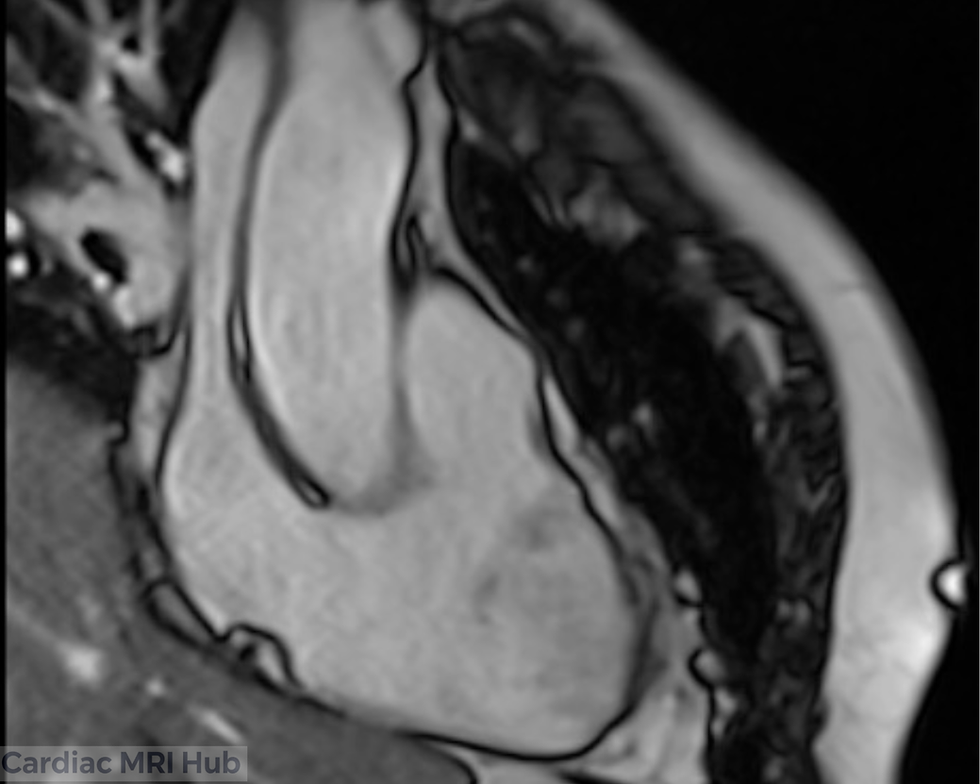
Aortic (LVOT)


Pulmonary (RVOT)


Lines shown to right and left show through plane planning for the RVOT or main pulmonary artery.

Pulmonary Arteries & Veins


MRA 4D Flow

Atrium Through Plane Planning

Bicaval Through Plane Planning

Mitral and Tricuspid Valve Through Plane Planning


Comments